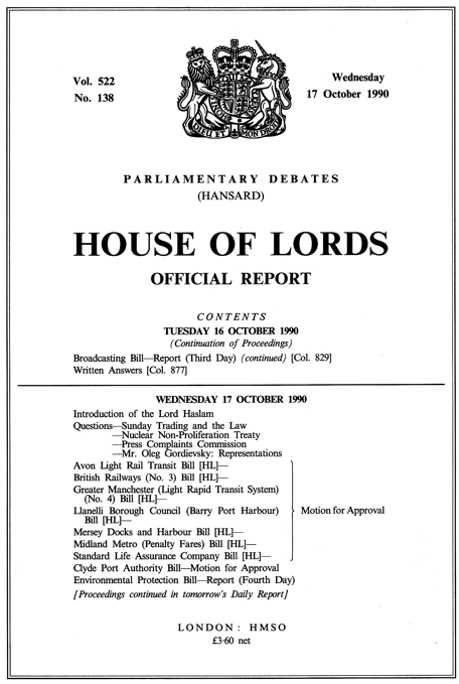
The Broadcasting Bill was debated for the final time in the The House of Lords on Monday 22nd October. Lord Monson again sought to introduce an amendment to the bill, that searches carried out on persons should be subject to the constraints of the Police and Criminal Evidence Act. Earl Ferrers assured the House that the amendment was “unnecessary and inappropriate”. In the absence of support for his proposal, Lord Monson withdrew this amendment and then moved another amendment, no. 113. This proposed that powers for boarding ships in international waters would not come into effect until twelve months after the date on which the 1982 United Nations Convention on the Law of the Sea has been ratified by no fewer than sixty States in accordance with international law. HANSARD House of Lords Official report 22th October 1990
Lord
Monson
My Lords,
we now return to the extremely important question of legality.
I was heartened by the assurance of the noble Earl last
Tuesday 16th October, in col. 830 of Hansard when he said that
new enforcement powers will be exercised in accordance with
international law. The difficulty is that not all those
enforcement powers can be used without contravening
international law as the latter stands at present.
Amendment
no. 113 may not be perfectly drafted but that can be corrected
in another place. It is designed to prevent the possibility of
the United Kingdom facing the embarrassment and possibly the
obloquy of being hauled over the coals by the international
court or possibly the European court for the breach of
international law that would occur if foreign registered
vessels were forcibly boarded and searched, and their
passengers also searched, on the high seas, without the
consent of the foreign government concerned, before at least
12 months had elapsed since the date when at least 60 states
have ratified the 1982 United Nations Convention on the Law of
the Sea. To do so before then would be illegal.
This
morning I received a long written opinion from a well-known,
highly respected firm of City of London solicitors
specialising in the law of the sea. Perhaps I may quote some
salient points from the letter. It says "In
our view, it requires positive international agreement before
national legislation permitting national authorities to
exercise jurisdiction over foreign flag vessels on the high
seas can be said to be in accordance with international law.
Therefore if and when HM Government adheres to the 1982 Law of
the Sea Convention" - they have not yet done so – "and
when its provisions come into effect, it will be arguable that
at least some of the powers contained in Schedule 14 will be
in accordance with international law (although some elements
may well be in breach of other provisions of international
law, such as the European Convention on Human Rights).
Therefore in our view, with the situation as it stands it is
simply untenable to say that the proposed powers are "in
accordance with international law".
Until such
time as the 1982 convention is ratified by the United Kingdom
and in force, perhaps the most important aspect, exercise of
the proposed powers against a foreign flag vessel other than
with the consent of the state concerned would be in breach of
international law. It is surely correct to say that none of us
wishes to see this country behaving in an illegal or even
bullying manner.
There are
quite enough countries in the world behaving badly as it is
and we do not want to find ourselves in their company. I beg
to move.
Earl
Ferrers
My Lords,
the noble Lord, Lord Monson, is concerned that we might be in
breach of international law. He was kind enough to say that I
had persuaded him more on the previous amendment than I had on
an earlier occasion. I shall see whether I can carry that
achievement further now.
Amendment
no. 113 would make the exercise of the enforcement powers
conditional upon the ratification of the United Nations
Convention on the Law of the Sea on which the noble Lord said
he had taken legal advice. I venture to suggest to him that
the amendment is unnecessary. I have given him the assurance
that the powers will be exercised in accordance with
international law. The powers do not hinge upon the convention
but upon the international radio regulations of the
International Telecommunications Union. These are already in
force. Therefore, there is no need to delay the exercise of
the powers until the convention is ratified. With that
explanation the noble Lord will see that we do not intend to
operate in breach of international law.
Lord
Monson
My Lords,
the noble Earl has not satisfied me. As I set out at length on
the previous occasion, various ministerial statements both in
this House and in another place have made it quite clear that
as the law then stood, despite the international radio
regulations to which the noble Earl referred, there was no
power to board foreign ships on the high seas without the
consent of the foreign power concerned.
Nothing
has changed. The only difference is that the 1982 UN
Convention on the Law of the Sea now potentially provides the
power, but it has not yet been ratified by 60 nations and it
cannot be binding until at least 60 nations have ratified it.
That is the crux of the matter. Nothing has changed since Mr.
Ted Short, as he then was, made the statement to which I
referred last Tuesday evening.
I am
somewhat surprised at the silence of noble Lords on the
Opposition benches because I should have thought they would be
concerned about the possible breach of international law by
this country. It will reflect badly on all of us if that takes
place. When the noble Earl assured me that no action would be
taken in breach of international law I was under the
impression that Her Majesty’s Government would delay the
exercise of this power notwithstanding the fact that the bill
would become law. The Government would simply sit on their
hands, so to speak, until such time as the 60 countries had
ratified the 1982 convention and would not take any action
against foreign registered ships on the high seas until that
time, in other words, the Bill would be enacted but this part
of it would not be used.
However it
now appears that the Government intend to proceed
straightaway, without waiting for 60 countries to ratify the
convention. In that case, the Government would be almost
certainly acting against the rules of international law. That
would be a great pity. Perhaps the noble Earl has further
information in his hands and wishes to make a further reply.
Earl
Ferrers
My Lords,
I do not wish to trespass on the patience of the House or to
break its rules but perhaps I may have the leave of your
Lordships to speak again.
The noble
Lord appears to take a great deal of persuading but I shall
have another shot at it. The powers will be exercised with
moderation and restraint. We intend to consult the flag state,
where there is one, to ensure that it does not object before
we act against a foreign flag vessel. Stateless vessels of
course are not under the diplomatic protection of any
government when on the high seas. Any force used will be kept
to a minimum.
The powers
are modelled on Articles 109 and 110 of the United Nations
Convention on the Law of the Sea. The noble Lord is perfectly
right that the United Kingdom has not yet become a party to
that convention. However that is for reasons totally
unconnected with radio. The exercise of the powers will be in
accordance with international law. That does not depend on the
convention coming into force or the United Kingdom becoming a
party to it.
I hope
that I have been able to take the noble Lord a little further
down the path with me.
Lord
Monson
My Lords,
I am grateful to the noble Earl for what he said. However, as
I said when speaking to the previous amendment, if he were to
guarantee his presence at the Home Office for many years to
come there would be no problem because he has given an
assurance at the Dispatch Box and that is good enough for me.
The trouble is that he is referring to executive action and
not statute law, which is a different matter.
I agree
with the noble Earl about stateless vessels. The Government
are perfectly entitled at the moment to take action against
stateless vessels, we do not quarrel about that. It is good to
know that the Government intend in practice to consult foreign
governments when it is proposed to board their vessels, but
there will be no legal obligation on the part of the
Government to do so, and therein lies the difficulty. We must
hope that the Government do the right thing notwithstanding
that the few is defective.
In the
absence, disappointingly, of support from any other part of
the House I beg leave to withdraw the amendment.
The House
of Lords then continued to discuss other aspects of the Bill,
before passing it that evening and returning it to the House
of Commons. The Broadcasting Bill received the Royal Assent on
1st November 1990 and comes into effect on 1st January 1991.
|
|---|
 |