The House of Lords had returned to debating the Broadcasting Bill at Report stage. On the morning of Tuesday 16th October, Lord Monson spoke of the proposed powers to forcibly board foreign ships on the high seas and of his amendment to restrict that proposal to only allow boarding if there was no conflict with international law…. HANSARD House of Lords Official report 16th October 1990 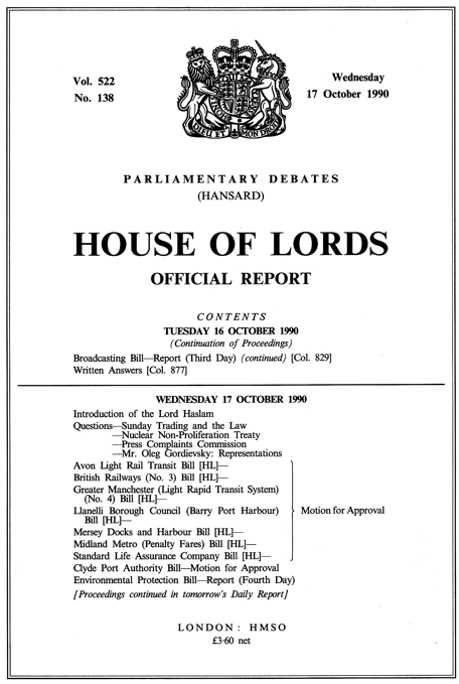
When we debated the matter in committee in July my noble and learned friend Lord Wilberforce, with all his enormous experience, very much doubted that all the powers conferred by Schedule 14 were in accordance with international law. His doubts are shared by a number of other legal experts. On the other hand, the noble Earl, Lord Ferrers, with all the expertise and resources of his department at his disposal, as well as those of the DTI think otherwise - even though the government concede that they are not relying on the effects doctrine, notwithstanding that the noble and learned Lord, Lord Wilberforce, maintained that the effects doctrine was the only conceivable justification for what the Government was trying to do. Since then the Gulf crisis has arisen and we have been able to see how cautious and reluctant member states of the United Nations are about permitting the stopping and boarding of vessels on the high seas even when it involves matters which are, objectively speaking, several hundred times as grave as the mere transmission of unauthorised broadcasts. Indeed the degree of force permitted in the course of stopping ships that may be carrying arms and vital strategic supplies to Iraq appears to be much more restricted and limited than the degree of force that Schedule 14 permits in order to stop the essentially harmless albeit illegal transmission of unauthorised broadcasts. Under international law we would still appear to be governed by the global radio regulations of the International Telecommunications Union adopted in 1959, the 1958 Geneva Convention and the 1965 Strasbourg Convention, none of which permits the boarding of foreign-registered vessels on the high seas merely for the purposes of stopping unauthorised broadcasting. On 18th June 1964 the noble Lord, Lord Newton, speaking in your Lordships house, told noble Lords that: "The Wireless Telegraphy Act 1949, does not extend to foreign registered or unregistered ships on the high seas, and it could not be amended so as to purport to extend to them without raising serious issues affecting the concept of freedom of the seas, and that is a concept which Her Majesty's Government are anxious to preserve."(Official report, 18.6.64 col. 1376) On 15th February 1967, Mr. Ted Short (as he then was) speaking in his capacity as Postmaster General, said in the House of Commons: "Obviously, we cannot legislate directly against broadcasting on the high seas in circumstances which would be outside the jurisdiction of our courts. Nor can other countries. It would not be consignant with international law in its present state" (Official report Commons, 15.2.67 col. 634) It is true that since then we have had the 1982 United Nations Convention on the Law of the Sea, which permits such action in certain circumstances. Unfortunately for the Government, hinging their case on the 1982 convention has two snags. The first is that the United Kingdom is not a signatory to that convention. The second and more important snag is that the convention has only been ratified by 41 countries and its provisions can only come into effect 12 months after at least 60 countries have done so. Obviously that will be some time off. The question appears to remain wide open therefore. Hence the vital necessity of this amendment or something like it. I beg to move.
Earl Ferrers My Lords, I have some sympathy with the noble Lords concern that the new enforcement powers should be exercised in accordance with international law. I can give him the assurance that the powers will be exercised in accordance with international law. But to require the United Kingdom courts to consider the state of international law, which is what amendment no. 333A would do, would be unprecedented. I suggest that this is neither necessary nor in that case desirable. Interpretation of international law is properly a matter for international courts, which already provide a remedy should enforcement action be taken which did not comply with international law.
Lord Monson My Lords, the statement by the noble Earl to the effect that the insertion of such a phrase in legislation would be without precedent casts a slightly different light on matters. I am reassured by his statement from the Dispatch Box. It will go down in Hansard and will be available to those who may wish to take note of it on future occasions. I should like to study the matter a little further and ask other people who are interested in this matter to study it as well. For the time being I beg leave to withdraw the amendment. Lord Monson then introduced amendment no. 333B which proposed safeguards on searches of persons on foreign ships. He continued that the Broadcasting Bill powers could mean that "civilians could be searched by members of the armed forces, women could be strip searched by men and the other way round, and both sexes could be intimately searched by someone with no medical knowledge or qualifications. I am sure that noble Lords would regard such a provision with abhorrence". Earl Ferrers assured Lord Monson that the powers of search would be in accordance with the Police and Criminal Evidence Act 1984 which safeguards individuals within the United Kingdom and added that this would apply "even if the powers are exercised outside the United Kingdom or the United Kingdom’s territorial waters". Lord Monson was not entirely convinced, but withdrew his amendment to consider the point further. The House then went on to discuss other aspects of the Broadcasting Bill. |
|---|
 |